I used to be just like all the haters, but at least I knew it:

The flow chart above was an attempt to understand why an upper middle class kid might simultaneously disdain popular hip hop for being "inauthentic" and "capitalist," fetishize popular music, and embrace underground hip hop or "backpacker rap." Starting from the foundations of rap as black counterculture, and moving down, I tracked an internal divide in hip hop music, and how both sects have been appropriated by white audiences. As the legend goes, mainstream hip hop's primary audience is white kids in the midwest. Think about all those Souljah Boy videos of girls in white tees and Clemson sweatpants. On the other hand, underground music has also been appropriated by a white audience, as a music that has some sort of power- in its perceived authenticity, and its anti-capitalist tendencies. Stop a random kid at an elite private college in the Northeast, ask him who his favorite rapper is, and you're as likely to hear the name Brother Ali as you are Biggie. The word "backpacker" has been thrown out in reference to this music, a term that resonates doubly, alluding to the purported "intellect" of underground music (backpacks), while also its appropriation into whiteness (backpacking, as in, rich kids hiking the Appalachian Trail). Listening to backpacker rap becomes a way for white kids to somehow gain a type of cultural "authenticity."
This is where I was at on 12/15/08.
I've moved in my position since then. For one thing, I have less criticism for mainstream hip hop as an entity. Simply put, Hot 97 made this summer for me. I've been all about
Throw it in the Bag,
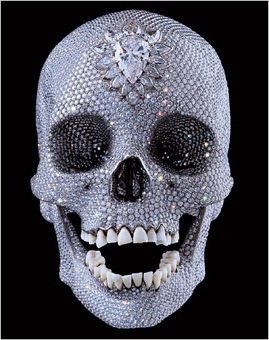
Who's Real, and that Hurricane Chris song about Halle Berry. For me, mainstream music has become so fascinated with an American construction of materialism that this very philosophy is no longer its purported downfall. In fact, it's one of the most outstanding, self-aware critiques of capitalism I know. We've seen sculptor Damien Hirst's
diamond skull, we know this Marxist critique of capitalism, it's old hat. Mainstream hip hop raises it one: critical acts from within capitalism's very framework. Fabolous bragging of his diamond-studded watch is an act of resistance, suggesting that the oppressive system isn't as far-reaching as it wants to be, and that some of the very people (young black males) who weren't suppose to acquire power, did. This is relevant in a way that a comfortable upper-middle class white guy calling out capitalism is not. It's also as powerful as any critique coming from backpack rap.
Thus, this post is dedicated to anyone who has off-handedly thrown out the terms "pop music" or "gangsta rap" or "popular rap" as an example of crappy music, or as a reference to the decline of American society. HI HATERS.
PS
There has been a rise of hybrid rappers lately, who question the boundary between mainstream and underground. This is a beautiful thing.